Travelogue: Memphis (2017)
6/17 Saturday
My son Ken and I made the eight-hour drive from Chicago to Memphis via I-57->I-55->I-40, stopping at the El Toro restaurant in Arcola, IL where I couldn’t resist the “Boss Burrito” with chicken and steak inside, shrimp and cream creole sauce outside. Then one last gas fill in West Memphis, AR.
We arrived at six, settled in at the Hampton Inn near Beale Street and then walked to Gus’s World Famous Fried Chicken but there were 20 people waiting, so we went down Pontotoc St. to Pearl’s Oyster House for oysters, crab cakes and fried fish, washed down with Yuengling on tap. Walked up and down Beale St. and found the inevitable wandering prophet with a sign: “Who is Jesus Christ? Lord. Liar. Lunatic. YOU MUST CHOOSE.” I chose nothing and moved on. There’s wasn’t much happening for a Saturday night until we settled on a band at Alfred’s. We got a couple of drinks at The Absinthe Bar and played pool with a brother/sister pair of college students. Then to the Flying Saucer on Peabody close to the hotel for some choice IPAs.
6/18 Sunday: Clarksdale, MI day trip
Up at 8AM for buffet breakfast and we hit the road to Clarksdale (80 miles SSW) on Rt 61 coasting past poorer neighborhoods of little groceries and gas stations until things got rural with the four-lane separated highway.
It was a Sunday, and downtown Clarksdale was deserted, like “The Andromeda Strain” but without the dead bodies. The only cars and activity were at The Ground Zero Blues Club at the end of Delta Avenue. We confidently walked right in and the place was jammed with middle-aged white folk watching a black woman alone on stage, singing with a Yamaha organ, like the House of Blues Gospel Brunch. Ken and I prowled the bar for a beer and then were unceremoniously told to leave the premises as this was a private party. So much for the “people’s music”. The other suggested attractions in town were mostly closed including the Delta Blues Museum and Deak’s Mississippi Saxophone and Blues Emporium with their world-class selection of harmonicas.
The Rock and Blues Museum was open and an old lady greeted us and got up with her walker to show us in. We spent a good hour browsing the massive private collection of memorabilia from Son House up to David Bowie and everything in between, the life’s work of Theo Dasbach. There were original invoices and gold records, a rectangular Bo Diddley guitar, a letter from the head of EMI records (the Beatles label) to Kit Lambert, the manager of the High Numbers (the group that would become The Who) to the effect that they couldn’t decide if the band had anything to offer. Most impressive were original nickel-plated father plates for vinyl record stamping. A signed master of Arthur Lee and Love. Sigh.
The nice museum lady with the bad legs suggested barbeque at Abe’s. “You’ll see the big pink pig outside.” Their brisket and pulled pork platters were lean and tasty, with the sweeter, thicker Tennessee-style sauce. Then Dad had to pull Ken into a cheesy tourist selfie outside with a backdrop of the crossed-guitar sign on a tall pole at the intersection of US Routes 49 and 61. Back in the car, Ken noticed a swarm of ants around his ankles, biting viciously.

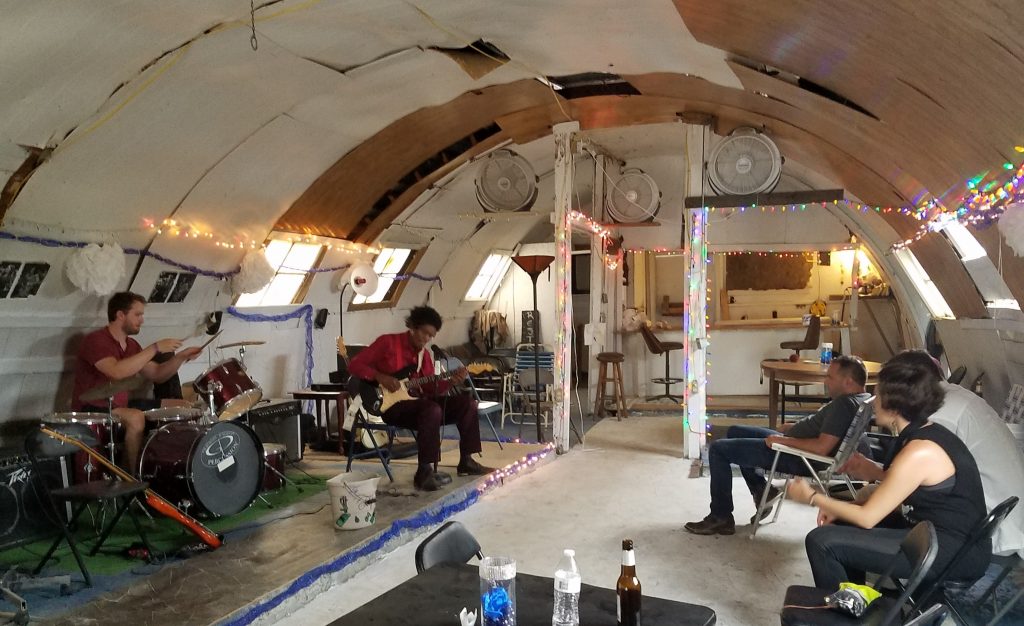
On a music site I’d seen notice of the nearby opening of a country juke joint called Wonder Light City. We drove about 18 miles out of town as dark clouds rolled in, from divided asphalt to two-lane country road to gravel as the rain was coming down in blinding sheets and we slowed to a crawl. It seemed much further than I thought. Just when I was about to turn around, we passed a wind-blocking line of trees to find a clearing with a demolished mobile home, a makeshift outdoor stage, and a Quonset hut painted blue and festooned with Christmas lights. Just inside there was a scattering of card tables, a stage made of pallets and plywood, and Robert “Bilbo” Walker, 80, in a maroon polyester ensemble and what looked like a Little Richard wig, and talking to a tourist family. Everyone was in a state of waiting. Robert explained that his band was severely delayed by the weather. I made my way to the back of the hut to a Formica-covered bar and a small woman who later was revealed as Robert’s wife and a soon-to-be bassist. She offered me the choice of Miller Lite or Bud Light and I chose two of the former and went back into the conversation. I mentioned offhand that Ken was a drummer and within minutes Robert was asking Ken to set up the drum kit the way he wanted so they could start. The old man spent a good 15 minutes tuning and trying to shake out the ground buzz from his amp patch cord until we hustled up another in the tangle of wiring at the side of the stage. Then he spent another 10 minutes helping his wife tune her bass, which was a full tone off, and teaching her how to play three notes in this sequence: A, D, E, which meant all the tunes had to be in the key of A. Then the bluesman started up a basic riff and off they went, Ken holding off until he caught the cadence. Robert had a fine, ragged guitar tone and a voice like Hound Dog Taylor. It all kind of came together and the family and I sat there as this pick-up band went through about a dozen songs. It must have been the poison ant bites at the Crossroads which filled Ken with some sort of preternatural rhythmic chops.
Back in Clarksdale we planned to top things off with a set at Red’s Lounge, which is supposedly open after 4PM on Sundays. Nope. Much of Clarksdale remained a ghost town, so we headed back to Memphis. This time we hit Gus’s again at 8PM and got a table quickly. And what they say is right. It’s the best fried chicken I’ve ever had—crunchy, with the right amount of spice on the outside, tender and moist on the inside. Afterwards we returned to Beale Street again for a great band at the Rum Boogie Café, and then back to the Flying Saucer to sample the lagers and pilsners.
6/19 Monday
The Lorraine Motel was one of the few designated for blacks in segregated Memphis in the 60s, and today is preserved as it was on April 4, 1968, when James Earl Ray holed himself up in the bathroom of the boardinghouse across the street with his Remington Model 760 rifle and put a bullet in the head of Dr. Martin Luther King who was standing on the balcony of Room 306. And it’s all there, as it was. The motel now houses the Civil Right Museum, with a wealth of multimedia exhibits bringing visitors from the dawn of slavery in the US to the current day.
Lunch was burgers at Huey’s on 2nd Street. The black fiberboard ceiling is porcupined with sandwich toothpicks. Our server provided us with an extra straw and a shot glass with toothpicks, their orange cellophane curlytails pointing upwards. The trick is to back-load the straw and impulse-blow the shaft upwards for a solid stick into the ceiling. The burgers ain’t bad, either.
We got to Sun Records too late for their 1PM tour, so Ken & I jumped back in the car to hunt down the original site of Ardent Studios between 1966 and 1971, which is kind of an underground Mecca for us as that is where Big Star recorded their first album. <as I wait for appreciative gasps> Well, at any rate we found it and now it’s a low-rent convenience store with bars across the windows. The auto parts store across the street was part of the Big Star grocery chain that gave the band its name one night when the group was loitering outside the studio smoking weed.

At Sun Records, everything is left pretty much the same as it was in 1954, with black marks on the tiled floor where Elvis, Bill Black, and Scotty Moore stood when they invented what was later called rock ‘n’ roll. After the tour, I asked the guide (an audio engineer) how Sam Phillips got the echo effect for the vocals as the studio is well-deadened. He took a couple of us back to the locked control room and explained that a radio broadcast mixer was used, with the “dry” vocal output routed to an Ampex reel-to-reel deck running at 7.5 inches/second which would give about half a second of “slapback” delay. Then he laughed and said that the RCA engineers would plead with Sam to give them the secret of the signature delay that he got on his records.
We had a 3PM worship-worthy tour of the Gibson Guitar factory. At that time, they were making the hollow- and semi-hollow ES-335 models there. If there’s a shiny, beautiful axe that fails final inspection due to a paint or finish flaw, they scrap it. Ken had to walk me out of the tour, weeping.
Dinner was at DeJavu Cajun restaurant on a long pedestrian mall near the business district. I ordered what turned out to be more-than-passable catfish slathered in a cream sauce of crabmeat, crawfish and shrimp. Then the nightly ritual of Beale Street—to BB King’s club with an incredible house band. The Flying Saucer was our nightcap, this time with a focus on session ales and porters.
6/20 Tuesday
Today we did what everyone who visits Memphis must do. Graceland. I came out of there admiring the fact that unlike George Vanderbilt or William Randolph Hearst who hired designers to produce tasteful mansions along the lines of an English manor home or a Spanish castle, Elvis insisted on Vegas Rumpus Room Chic where mirrors are the aesthetic and no leopard hide is safe. Elvis made no apologies for Bedouin-tent game rooms in the basement, a leather-clad lounge facing the racquetball court, nor the infamous “Jungle Room” like some Hollywood producer’s wacked-out vision of a safari lodge. I can’t think of a place more representative of pop-culture America.

Lunch was at Marlowe’s about a mile up the road. Elvis memorabilia was everywhere. Our Brazilian waitress knew almost nothing about the history of the place, but there was an autographed white jacket framed on the wall addressed to the owner. They had ribs, served with sauce on the side, that easily slipped off the bone but the meat didn’t fall apart. The way it should be.
Next stop was Stax Studios, home to “The Memphis Sound” which was the more soulful, funkier alternative to Motown in the Sixties: Otis Redding, Wilson Pickett, Carla Thomas. Booker T. & the MGs were the house rhythm section, racially integrated like much of the city is today. Essential. From 2-4 PM a group featuring alumni of the Stax Music Academy played some of the classics in Studio A.
Driving back to our hotel, I remembered that I wanted to locate and take a picture of the current Ardent Studios, where the Replacements, the Cramps, and Big Star recorded. I parked on the street next to the place and walked in to ask permission to take a few pictures. Two young guys were at desks in the office off from the foyer. One of them said, “Just a minute” and walked around the corner, then returned with a guy around my age with long brown hair, dressed in jeans, sneakers, a checkered shirt. The young guy said, “This is Jody.” It was Jody Stephens, the last remaining member of Big Star, drummer for Golden Smog, and one of the managers at Ardent. After I picked up my jaw from the floor, I introduced myself and Ken. Jody spent a half-hour chatting with us about the old days, what he’s been doing, and the Chicago music scene. He showed us around the place including Studio B with his original drum kit from the early Seventies.

We wrapped up our museum frenzy with the Memphis Rock & Soul Museum (somewhat cool, but redundant, given all we had seen at Sun and Stax). Our last dinner was at Maciel’s Tortas and Tacos on Main, then back to the Rum Boogie Café for an average R&B band with an incredible guitar player who alternated between finger- and flat-picking and threw jazz runs into a standard blues progression. Maybe he’d been to the Crossroads …
Midnight. Four beers gone at the Flying Saucer. I asked them to break the seal on a fresh bottle of Macallan 12-year single malt. Memphis. I’ll be back.
